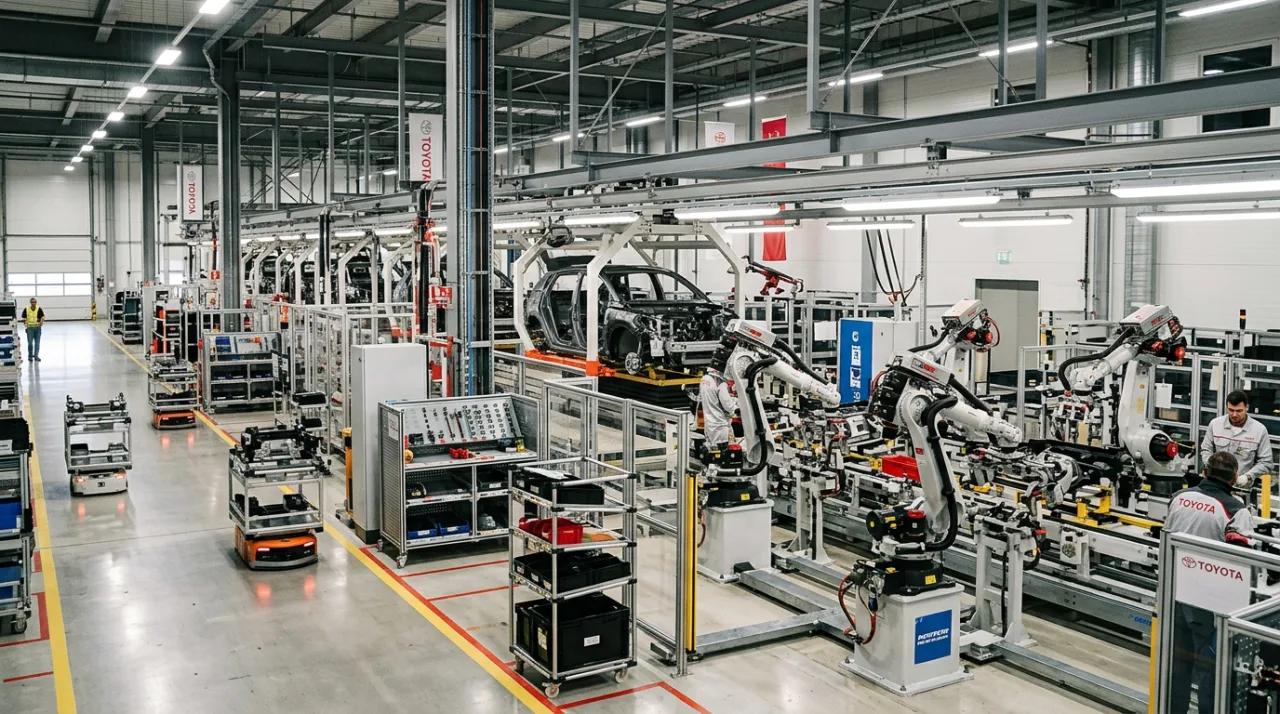
Toyota Group estimates annual factory automation spending of approximately ¥1 trillion, or $6.4 billion, beginning in 2028. The initiative could involve deployment of roughly 400,000 robots, combining humanoid-style units with conventional industrial models, across Toyota plants, group companies, and key suppliers.
Toyota Robotics Deployment Scale and Timeline
The plan allocates about 150,000 robots to Toyota’s own manufacturing sites and another 250,000 units to affiliated companies and suppliers. These figures cover both replacement of aging equipment and new installations focused on industrial robots, automated logistics systems, and collaborative human-robot cells. Estimates were presented to investors in September 2026, with physical rollout scheduled to accelerate from 2028 onward.
Deployment will occur progressively during scheduled factory upgrades rather than through a single fixed multi-year contract. Toyota has not yet disclosed an exact total duration or final investment ceiling, leaving room for adjustments based on technology maturity and production needs. The effort forms part of a wider modernization of facilities that currently produce nearly 10 million vehicles each year.
Executive Vice President Hiroki Nakajima stated the goal is a world in which robots coexist with humans rather than displace them. The approach addresses labor shortages and an aging workforce while capturing expertise from approximately 18,000 veteran “takumi” workers across 60 global plants.
ELEY Platform, Walden Robotics, and Training Methods
The flagship ELEY wheeled platform, developed internally, stands between 94 and 162 centimeters tall, weighs about 50 kilograms, and uses two-fingered grippers on an omnidirectional base. It employs quasi-direct-drive actuators for safe backdrivability and learns tasks through human demonstration captured via finger jigs and vision-based large behavior models. In one test, units achieved near-perfect T-shirt folding after roughly 1,500 demonstration sessions over two weeks.
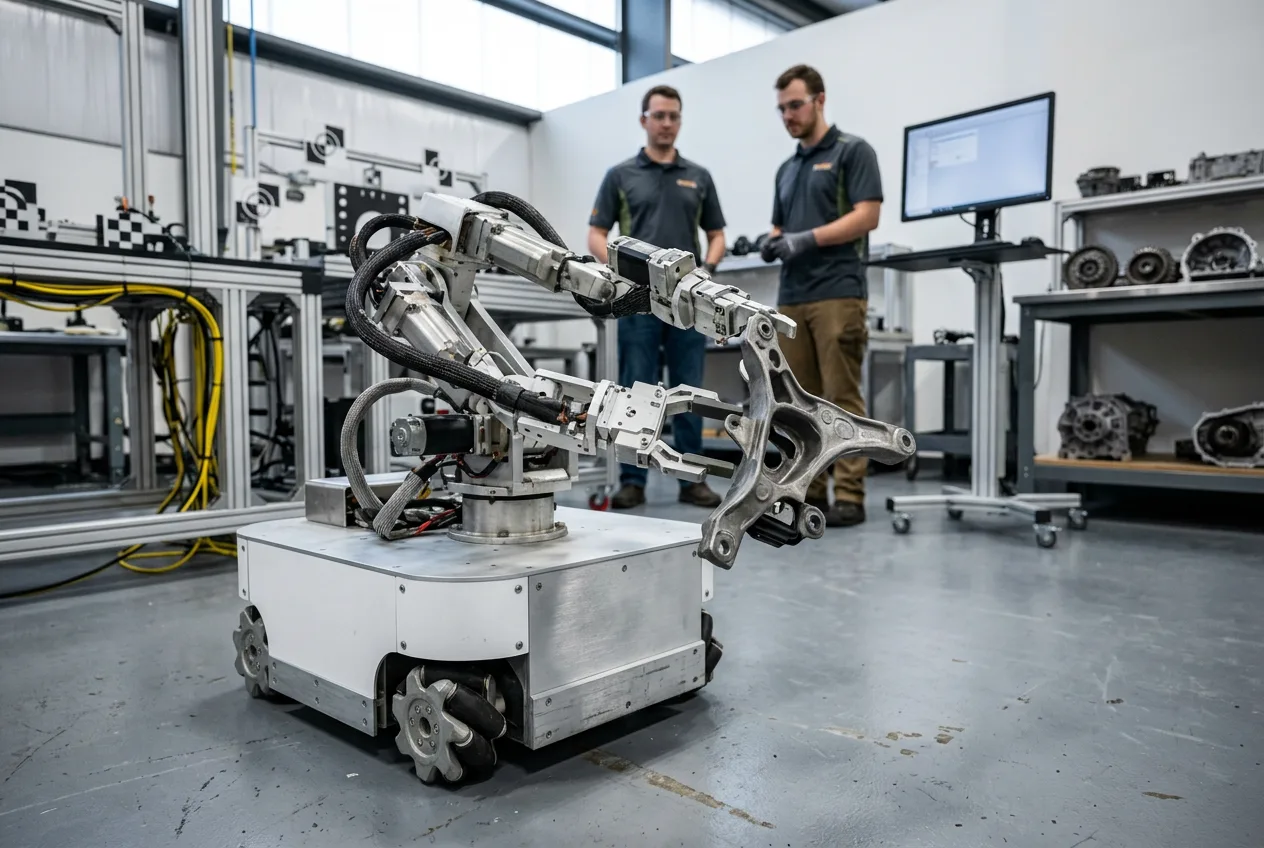
Walden Robotics, a Toyota Research Institute spinout that launched in July 2026 with $300 million in funding at a $1.1 billion valuation, already operates similar wheeled humanoids in a North American Toyota plant for machine tending and kitting. Data collected from demonstration sessions can be shared centrally, allowing skills learned at one site to transfer to others without repeated on-site training.
Robots are trained directly by observing skilled workers on active assembly lines instead of relying primarily on simulation. Several ELEY units have begun collecting data in production environments. This method preserves institutional knowledge while supporting consistent quality across Toyota’s global network.
Factory Automation Context and Next Steps
Toyota’s robotics push builds on earlier projects such as the HSR service robot and T-HR3 humanoid prototype. It coincides with parallel efforts by other automakers, including Hyundai’s planned humanoid deployments from 2028 and Tesla’s Optimus program. The company positions the technology as a tool to maintain competitiveness amid global supply-chain pressures rather than a route to immediate workforce reduction.
Recent reporting from October 2026 indicates Toyota continues to formalize its robotics organization and refine investment models. Actual annual expenditures and the precise ratio of humanoid to conventional robots will depend on further engineering validation and factory-by-factory upgrade schedules. Suppliers and group companies are expected to align their own automation roadmaps with the same 2028 starting point.
Frequently asked questions
When will Toyota begin deploying the 400,000 robots?
Toyota plans to ramp up robot installations from 2028, with spending estimates of $6.4 billion per year once the program is active. The timeline aligns with scheduled factory modernization cycles rather than a single launch date.
What is the ELEY robot and how does it learn tasks?
ELEY is Toyota’s wheeled humanoid-style platform that uses vision-based models and human demonstration data. Workers wear finger jigs while performing tasks; the robot records and replicates the motions, achieving high accuracy after repeated sessions.
How does Walden Robotics fit into Toyota’s plans?
Walden Robotics, spun out from Toyota Research Institute in July 2026, supplies wheeled humanoids already operating in a North American Toyota plant for machine tending and kitting tasks, supporting the broader deployment strategy.
Will the robots replace human workers at Toyota plants?
Toyota executives state the goal is coexistence with humans to address labor shortages and preserve skilled expertise. The program focuses on collaboration rather than direct replacement.
By YasTech Editorial
Comments 1