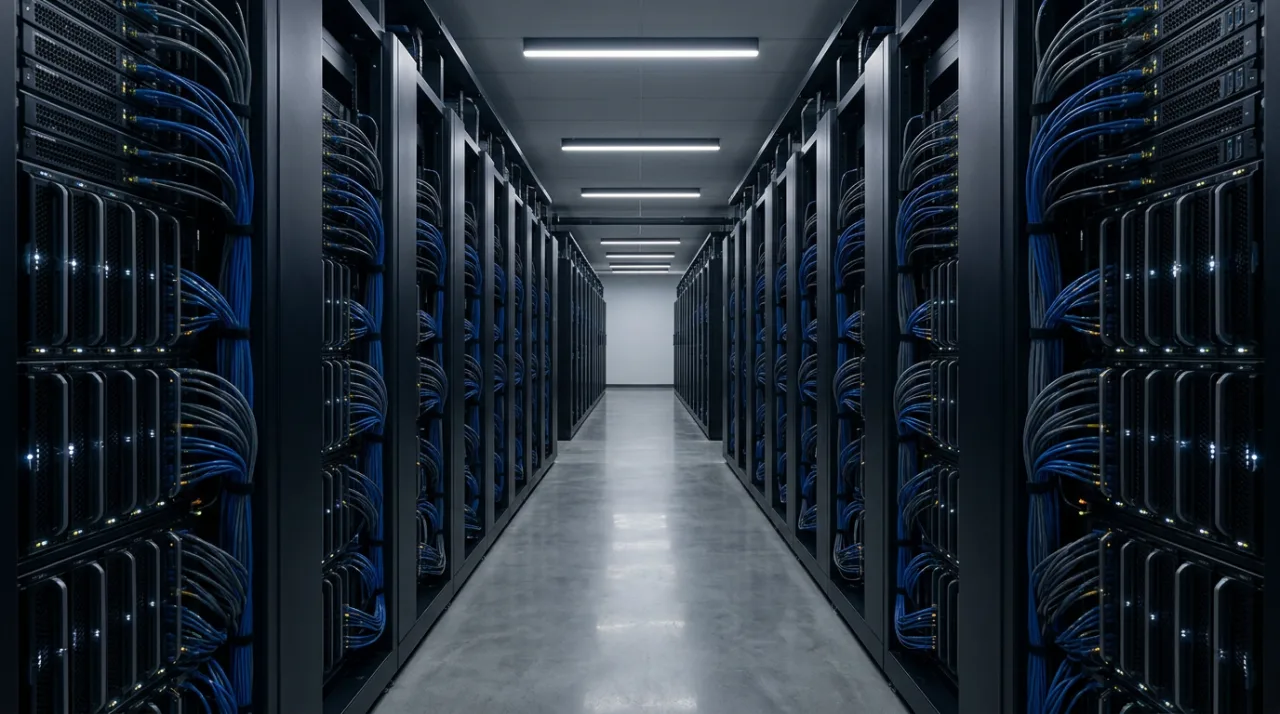
Reflection AI, the Brooklyn startup founded in 2024 by former Google DeepMind researchers, published its Beam model on October 5, 2026. The company released full weights under an Apache 2.0 license on October 16, 2026, making the 501.3-billion-parameter sparse mixture-of-experts model available for self-hosting and commercial use.
Architecture, Training Scale and Technical Specifications
Beam is a text-only sparse MoE model with 501.3 billion total parameters and 23.4 billion active parameters per token. It uses 52 layers, including three dense layers and 49 MoE layers with 256 routed experts and top-8 routing. The model supports a 1-million-token context window through mixed sliding-window and full attention with grouped-query attention, a 152k vocabulary, and a knowledge cutoff of June 30, 2026.
Pretraining consumed 23.8 trillion curated tokens from web and licensed sources. The run completed in under four weeks on 6,144 NVIDIA GB300 GPUs. A subsequent high-compute reinforcement-learning stage used more than 100 million rollouts across roughly 10,500 GB300 GPUs over four weeks and involved 1.3 billion sandbox environments. The release includes BF16, FP8 and NVFP4 quantized weights, a 1.93-billion-parameter speculative drafter called DFlash2, the tokenizer, reference implementation, model card and safety report.
Reflection also published the Mirror CLI open-source agent harness alongside the weights on Hugging Face under the reflection organization. The company positions the model as a Western open-weight option that prioritizes inference efficiency and token economy rather than raw parameter count.
Benchmarks, Deployment Options and Developer Impact
Reflection reports the following scores on vendor benchmarks: 80.9–81.6 on SWE-bench Verified, 80.1 on Terminal Bench v2.1, 90.5 on GPQA Diamond and 43–44.4 on DeepSWE v1.1. The company claims the model requires three to four times lower inference compute on reasoning tasks compared with GLM-5.2 while remaining competitive with larger models such as GLM-5.3, Kimi K3 and DeepSeek V4.1 Flash on agentic and coding workloads. Independent verification of these numbers is still pending.

Users can access Beam through self-hosted weights, the Reflection API with an OpenAI-compatible endpoint, or more than 40 partner integrations. Supported platforms at launch include AWS SageMaker, Google Cloud, Azure, CoreWeave, Fireworks, vLLM, SGLang, Ollama and NVIDIA NIMs. Quantized variants and the speculative drafter reduce memory and latency requirements for production agent deployments.
Developers working on long-horizon agent systems or code-generation pipelines gain immediate access to a licensed open-weight model that balances scale with practical inference cost. The Apache 2.0 license permits commercial fine-tuning and derivative work without additional restrictions beyond standard attribution.
Company Roadmap and Expected Ecosystem Growth
Beam follows Reflection’s $25 billion valuation funding round and large-scale GPU cluster agreements. The company has outlined plans for additional models in the series, fine-tuning and RL recipes, expanded harness integrations, and self-distillation tools. Ongoing partner deployments and developer customization efforts are already underway.
Organizations evaluating open-weight models for internal coding assistants or autonomous agent frameworks can now run controlled comparisons against closed models using the released weights and Mirror CLI harness. Safety evaluations and independent benchmarks are expected to appear in the coming weeks as more teams deploy the model.
Frequently asked questions
What license covers the Reflection AI Beam weights?
The weights, tokenizer and reference implementation are released under the Apache 2.0 license, allowing commercial use and derivative models with standard attribution.
How many active parameters does Beam use during inference?
The 501.3-billion-parameter model activates 23.4 billion parameters per token through its sparse MoE design with top-8 expert routing.
Which platforms support Beam at launch?
Self-hosting via Hugging Face, the Reflection API, and integrations with AWS SageMaker, Google Cloud, Azure, CoreWeave, Fireworks, vLLM, SGLang, Ollama and NVIDIA NIMs are available.
What context length does the model support?
Beam handles up to 1 million tokens using a combination of sliding-window and full attention with grouped-query attention.
By YasTech Editorial
Comments 1