
Mueon Corporation of Portland, Oregon, announced a $65 million Series A round on October 15, 2026, led by Maverick Silicon. The round brings total funding above $80 million after a $15.5 million seed round in September 2025. Investors include Intel Capital, Geodesic Alliances Fund, Oregon Venture Fund, M-Ventures, Wellington Capital, IQT and Defined.
Mueon Series A details and planned use of capital
The new capital will expand engineering and operations teams while moving Cubelets from platform development into broader system validation and production readiness. Company executives stated that customer engagements will deepen in parallel with these technical milestones. No revenue figures or exact production start dates were disclosed.
Since the seed round the firm has advanced four parallel tracks: silicon and system architecture, advanced integration covering packaging power and thermals, software and orchestration layers, and ecosystem validation with partners. The Series A round adds board members Manish Muthal from Maverick Silicon and Srini Ananth from Intel Capital.
Co-founder and CEO Wilfred Gomes previously worked at Intel on die-stacking projects. Co-founder and CTO Jack Hwang also came from Intel, where he focused on transistor etching techniques. Their combined experience informs the hardware approach now moving toward larger-scale deployments.
Cubelets architecture targets efficiency in AI data center hardware
Cubelets are modular, stackable 3D compute and memory blocks that combine compute, memory, interconnects, power delivery and thermal management inside each unit. The design reduces data movement and infrastructure overhead by integrating these elements at the system level. Mueon states the architecture can deliver up to 10 times better power and cost efficiency within the same rack footprint while scaling toward megawatt-class density.
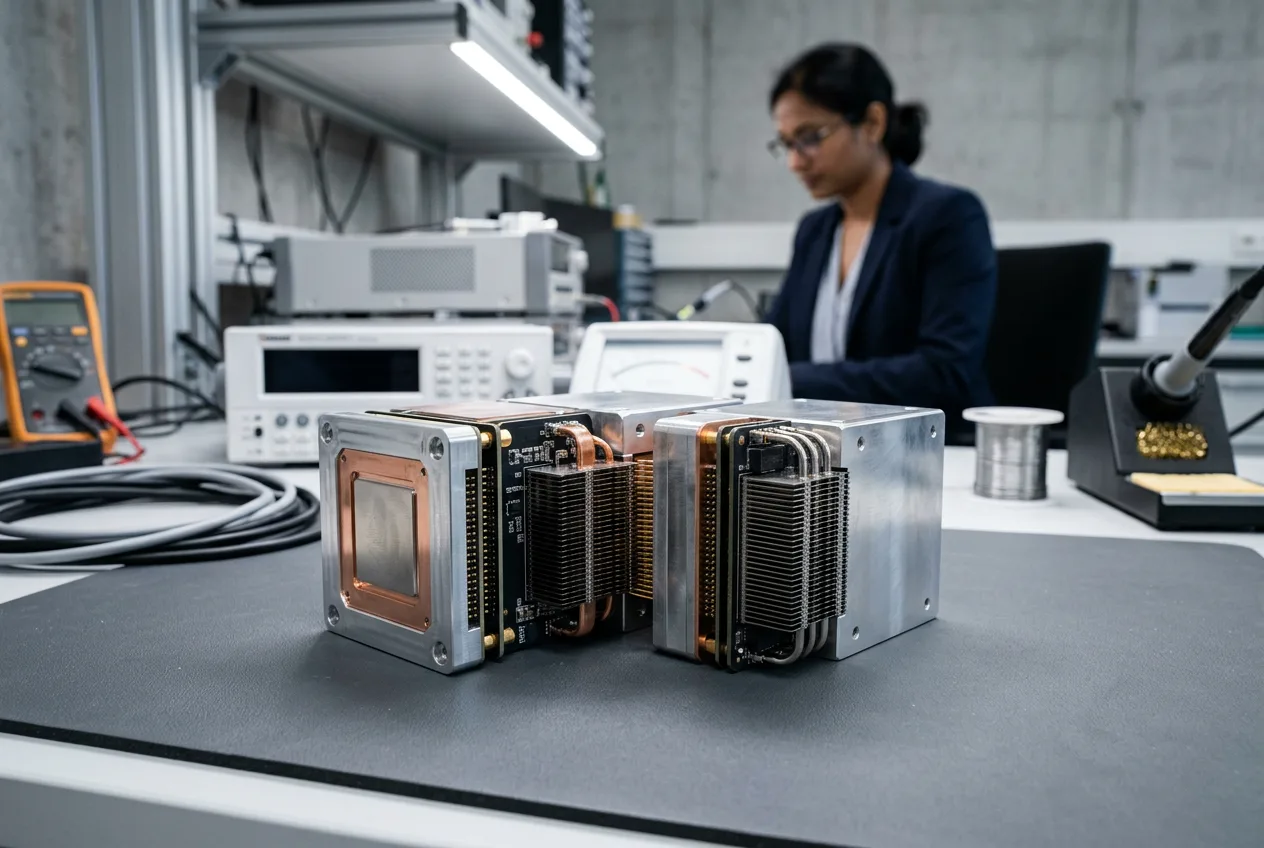
The platform supports multiple chip types including GPUs and Arm CPUs. Software development focuses on compatibility with common AI frameworks. Early validation work has involved partners testing integration with existing hyperscale environments. These company-stated performance targets remain subject to independent verification once production systems ship.
Compared with traditional rack-scale designs, the modular approach aims to shrink the physical and power footprint required for large AI training and inference clusters. Semiconductor systems that pack compute and memory closer together can lower latency and energy use per operation. Mueon positions Cubelets for both AI training clusters and inference workloads at hyperscale operators.
Next engineering and validation milestones
Immediate priorities include continued hiring in engineering and operations, expanded system-level validation, and preparation for production readiness. The company will also broaden customer pilot programs to gather feedback on integration with existing AI software stacks. No timeline for volume shipments has been released.
Industry observers note that modular 3D packaging concepts have gained traction as power and cooling limits constrain further scaling of conventional server racks. Mueon’s focus on integrated power delivery and thermal management inside each Cubelet addresses two of the largest cost drivers in new AI data center builds. The $65 million round provides runway for these hardware and software efforts through at least the next major validation phase.
Frequently asked questions
What is the Cubelets platform?
Cubelets are modular 3D compute and memory blocks that integrate processing, memory, interconnects, power and cooling inside stackable units. The design targets higher density and lower power use for AI workloads.
Who led Mueon Series A funding?
Maverick Silicon led the $65 million round announced October 15, 2026. Intel Capital, Geodesic Alliances Fund and several other investors participated.
How much has Mueon raised in total?
Total funding now exceeds $80 million after the Series A and a $15.5 million seed round completed in September 2025.
What will the new funding support?
Funds will expand engineering and operations teams, advance Cubelets toward production readiness, and support wider customer validation programs.
By YasTech Editorial
Comments 5