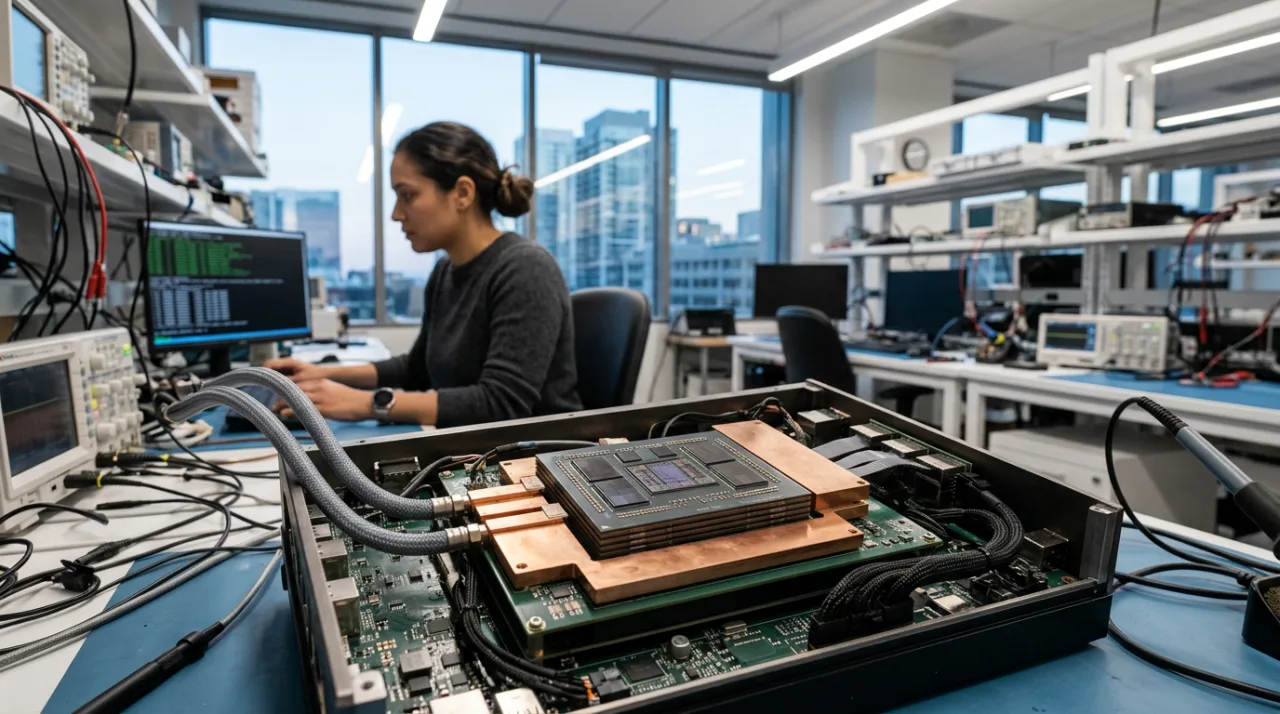
Microsoft announced the Azure Maia 300, its third-generation custom AI inference accelerator, on October 12, 2026, at the OCP Global Summit in San Jose. The chip targets multi-gigawatt scale for Azure inference workloads beginning in 2027.
Microsoft Maia 300 Architecture Delivers Efficiency Gains
The Maia 300 uses a multi-chiplet design built on TSMC N2P process technology. Each accelerator carries eight HBM4 stacks that provide 288 GB capacity and 18 TB/s peak bandwidth, along with a 950 W TDP rating. Peak compute reaches 13.8 POPS in FP4 and 6.9 POPS in FP8, supported by bidirectional scale-up bandwidth of 3.2 TB/s and a PCIe Gen6 x16 host interface.
Microsoft states the new design achieves up to seven times rack-scale token throughput compared with a full Maia 200 rack. It also delivers more than 2.5 times performance per watt and roughly twice the HBM bandwidth per watt versus the prior generation. Additional gains include 36 percent more system compute FLOPs, 2.5 times HBM bandwidth, 33 percent more HBM capacity, and 14 percent more scale-up bandwidth. Microsoft projects the platform will deliver 40 percent more tokens per megawatt than leading GPU-based systems.
A 96-accelerator rack configuration consumes 167 kW and relies on liquid cooling for more than 80 percent of heat removal. The rack supplies 27.6 TB total HBM capacity and 1.7 PB/s aggregate HBM bandwidth. A two-tier Ethernet scale-up network with custom AI transport enables superpods of up to 12,288 accelerators across 128 racks. These specifications focus on long-context and agentic inference tasks that require high memory capacity and low latency.
Path to Multi-Gigawatt Deployments Starting 2027
Production deployments of the Maia 300 begin in 2027. Microsoft intends to expand the Maia family to multi-gigawatt capacity starting that year and position the platform as the primary inference system for its own products and services. The announcement follows the current Maia 200 generation, which entered production on a monolithic N3P process with 216 GB HBM3E memory and 750 W TDP.

Maia 200 systems now operate across the United States, Europe, and Australia. They support Microsoft Copilot, OpenAI models, Microsoft MAI models, and open-source families, delivering up to 1.7 times more tokens per watt than leading GPU infrastructure for Teams and Copilot features. GitHub Copilot and Microsoft Foundry workloads are expected to move to Maia 200 by the end of 2026.
The Maia program emphasizes co-design for inference rather than training. Azure customers will gain access to the new hardware once internal capacity targets are met, though exact timelines for third-party availability remain undisclosed. Independent benchmarks and the precise GPU baselines used for the 40 percent tokens-per-megawatt claim have not yet been published. The shift to multi-gigawatt scale will require continued advances in power delivery, cooling infrastructure, and network fabric design to maintain efficiency at that level.
Frequently asked questions
When will Microsoft Maia 300 enter production?
Production deployments of the Maia 300 accelerator begin in 2027, with Microsoft planning multi-gigawatt scale across Azure data centers starting that year.
How does Maia 300 compare to Maia 200 in performance per watt?
Microsoft reports more than 2.5 times performance per watt and roughly twice the HBM bandwidth per watt compared with the Maia 200 generation.
What memory configuration does the Maia 300 use?
Each accelerator includes eight HBM4 stacks delivering 288 GB capacity and 18 TB/s peak bandwidth on the TSMC N2P process.
Which workloads will run on Maia 300 systems?
The platform targets long-context and agentic inference tasks for Microsoft Copilot, OpenAI models, Microsoft MAI models, and open-source families once capacity expands.
By YasTech Editorial
Comments 1