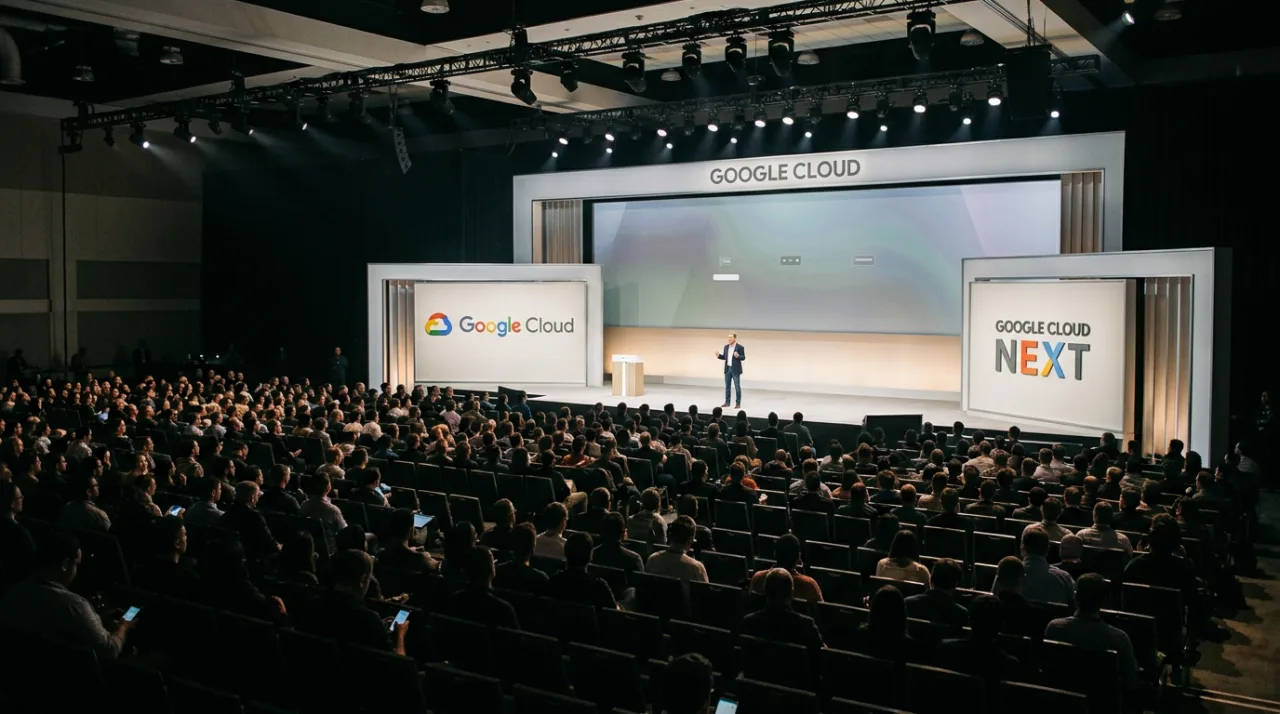
Google Cloud Next 2026 took place April 22–24 at the Mandalay Bay Convention Center in Las Vegas and attracted more than 30,000 attendees. The event presented the rebranding of Vertex AI into the Gemini Enterprise Agent Platform along with new Google Distributed Cloud capabilities aimed at regulated industries.
Google Cloud Next 2026 Focuses on Enterprise AI Agents and Data Residency
The Gemini Enterprise Agent Platform consolidates agent tooling, model access, development, orchestration, governance, and observability under a single framework labeled Build, Scale, Govern, Optimize. Underlying Vertex AI APIs remain compatible, allowing existing customers to migrate without code changes. The update targets enterprises that have moved past pilot projects and now require governed, observable agent deployments at scale.
Google also introduced the Agent Compute Engine in preview. The service supplies hardware-isolated microVMs for individual AI agents, promising up to 10 times higher compute density and improved security isolation. Additional infrastructure announcements included general availability of eighth-generation TPUs, Axion processors, and enhanced networking tailored for agentic workloads.
These changes address the practical needs of organizations in finance, defense, and public sectors that must balance AI adoption with strict compliance requirements. Early adopters can test the new platform through existing Google Cloud accounts while maintaining current billing and quota structures.
Sovereign Cloud Expansions Support Regulated Industries
Google Distributed Cloud received several updates for air-gapped and connected deployments. Gemini 3.5 Flash reached general availability in air-gapped environments, and support expanded for open-weight models including Gemma and Mistral. Enterprise search capabilities entered preview, and NVIDIA HGX B300 GPUs became generally available on air-gapped instances.

New controls include Confidential External Key Management and three deployment modes: Google Cloud Data Boundary, Dedicated, and air-gapped or connected Google Distributed Cloud. These options let organizations meet data residency and sovereignty rules without sacrificing access to current Gemini models.
Analyst reports from Forrester and Gartner positioned Google as a leader in sovereign cloud platforms for 2026. The updates build on earlier agentic AI initiatives and respond to customer demand for production-grade controls in sensitive environments. Follow-on details appeared at the NVIDIA GTC Berlin event and the Google Public Sector Summit later in 2026.
Next Steps for Google Cloud Customers
Preview features such as the Agent Compute Engine and enterprise search are scheduled to reach general availability in the coming quarters. Google plans additional regional sovereign deployments and expanded partnerships with hardware and software vendors. The next Google Cloud Next event is set for April 13–15, 2027, again in Las Vegas.
Enterprises evaluating these tools should review their current data governance policies against the new deployment modes. Organizations already using Vertex AI can begin testing the Gemini Enterprise Agent Platform through the unified console while monitoring quota and billing impacts.
Frequently asked questions
What replaced Vertex AI at Google Cloud Next 2026?
The Gemini Enterprise Agent Platform replaced the previous Vertex AI branding. It unifies agent tooling, governance, and observability while keeping existing APIs compatible.
Which industries benefit most from the new sovereign cloud features?
Public sector, defense, and finance organizations gain the clearest advantages. These sectors require strict data residency and air-gapped AI model execution.
When will the Agent Compute Engine reach general availability?
Google has scheduled the Agent Compute Engine preview to move to general availability in the coming quarters, though no exact date has been published.
Does Google Distributed Cloud support open-weight models?
Yes. Air-gapped Google Distributed Cloud instances now support Gemma, Mistral, and additional open-weight models alongside Gemini 3.5 Flash.
By YasTech Editorial
Comments 3