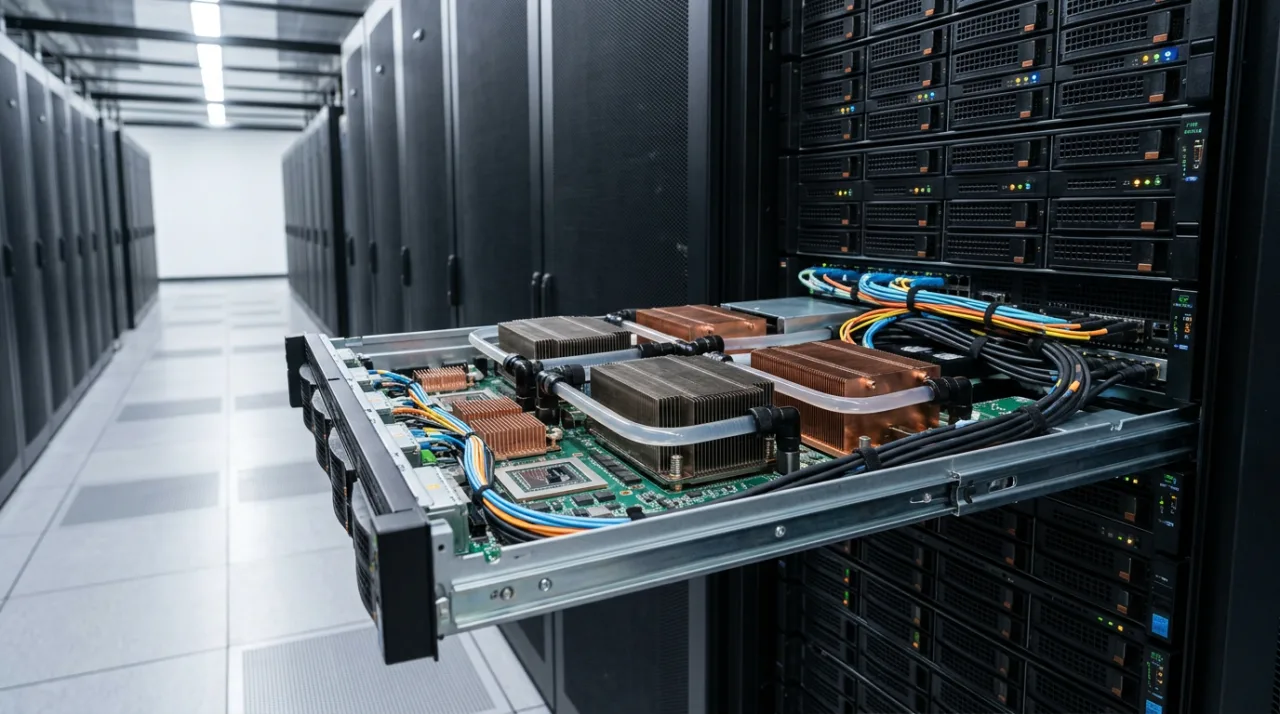
Google Cloud introduced the Ironwood TPU, its seventh-generation accelerator, in November 2025 with general availability following shortly after. The platform targets high-volume inference workloads and forms the core of the AI Hypercomputer offering. Enterprises now gain access to chips that deliver measurable cost advantages over prior TPU generations while supporting both training and agentic inference tasks.
Google Cloud AI platform Delivers Performance and Cost Improvements
Ironwood achieves more than four times the performance per chip compared with Trillium for both training and inference. Peak improvements reach ten times the level of TPU v5p in selected workloads. Power efficiency doubles versus the previous generation, and pods scale to 9,216 chips with 9.6 Tb/s inter-chip interconnect and 1.77 PB of shared high-bandwidth memory.
Third-party analyses indicate cost-per-performance gains of 19 to 50 percent versus comparable Nvidia offerings, depending on model size and workload. Historical TPU v5e pricing already showed hourly rates roughly 40 percent below A100 GPUs, and Ironwood extends this trajectory through architectural refinements and software stack optimizations. Current on-demand pricing lists Ironwood at $12.00 per chip-hour in us-central1, with commitment discounts ranging from 30 to 55 percent and spot options available.
GKE Inference Gateway and vLLM support on TPU produce up to 30 percent lower serving costs and 96 percent reductions in time-to-first-token latency. TorchTPU, open-sourced in October 2026 with Meta, enables native PyTorch, vLLM, and SGLang execution, with reported costs reaching 2.01 cents per million tokens on benchmark suites.
Enterprise Adoption and Multi-Cloud Expansion
The shift toward agentic workflows has increased demand for predictable, low-latency inference at scale. Google Cloud now extends TPU access beyond its own regions through the Oracle Cloud partnership announced in October 2026, with availability scheduled for 2027. This arrangement allows enterprises to run the same Ironwood pods across multiple providers without rearchitecting applications.
Software enhancements continue through vLLM and SGLang integrations plus ongoing GKE updates. Future roadmaps reference TPU v8 designs that separate training and inference architectures, alongside cluster expansions that target hundreds of thousands of chips. These developments give decision-makers concrete levers for controlling compute spend while meeting latency targets for production models.
What the Changes Mean for Enterprise AI Teams
Teams evaluating cloud infrastructure can now model total cost of ownership using verified per-chip pricing and published efficiency metrics. The combination of higher pod scale, improved interconnect bandwidth, and open-source inference engines reduces the barrier to deploying large context windows and multi-agent systems. Organizations already committed to Google Cloud gain immediate access, while multi-cloud strategies benefit from the forthcoming Oracle integration.
Practical next steps include running controlled benchmarks on Ironwood pods through existing GKE environments and comparing results against current Trillium or v5p deployments. Commitment-based pricing and spot capacity further improve economics for steady-state inference traffic. Continued software releases through 2027 are expected to widen these advantages.
Frequently asked questions
How does Ironwood TPU compare in cost to TPU v5?
Analyses show Ironwood delivers 19 to 50 percent better performance per dollar than prior generations and Nvidia equivalents in many workloads. On-demand rates stand at $12 per chip-hour, with discounts lowering effective costs further.
When will Oracle Cloud customers access Ironwood?
The partnership announced in October 2026 schedules TPU availability on Oracle Cloud for 2027, expanding multi-cloud options for enterprise users.
What software tools support Ironwood inference today?
GKE Inference Gateway, vLLM, SGLang, and the open-source TorchTPU stack enable deployment. These tools have demonstrated up to 30 percent serving cost reductions and major latency improvements.
Which workloads benefit most from Ironwood pods?
High-volume, low-latency inference for agentic systems and large language models sees the largest gains, alongside training and reinforcement learning tasks that require scalable interconnect.
By YasTech Editorial
Comments 1