Epoch AI published its latest analysis on October 29, 2026, showing that global AI computing capacity additions, measured in H100-equivalent chips, have doubled every nine months since 2024. The report aggregates sales data from Nvidia, Google, AMD, Amazon, Huawei, and Cambricon and fits an exponential trend to quarterly figures updated through mid-October 2026.
The pace marks a slowdown from the roughly sixfold annual growth recorded in 2023 after the initial GPT-4 release, yet it remains rapid enough to reshape data center planning worldwide. US-based facilities captured 72 percent of new capacity since 2022 and 78 percent in the first half of 2026.
Quarterly Capacity Additions and Chip Sales Growth
Epoch converts vendor sales into H100-equivalent units to create a consistent time series. Quarterly additions have risen about 2.5 times per year on average since 2024, producing the observed nine-month doubling interval. The firm notes some signs of further moderation but finds no statistically significant break in the trend.
Nvidia's data-center segment, which accounts for nearly 90 percent of its revenue, reached full-year fiscal 2026 totals of approximately 215.9 billion dollars, up 65 percent from the prior year. Hyperscalers and large enterprises continue to drive sequential gains as Blackwell systems ramp. AMD, Google, and Amazon each contribute measurable shares, while Huawei and Cambricon supply the majority of capacity deployed in China.
Installed stock of AI compute has expanded at a slightly faster 3.3 to 3.4 times per year since 2022, doubling roughly every seven months, according to Epoch's earlier January 2026 dataset. Nvidia retains more than 60 percent of cumulative production across that period.
Geographic Distribution and Data Center Infrastructure Pressures
US dominance reflects both domestic hyperscaler spending and export controls that limit advanced chip shipments elsewhere. China's share of new capacity sits near 10 percent, lower than its share of physical chip counts because of performance differences and restricted access to leading-edge designs.
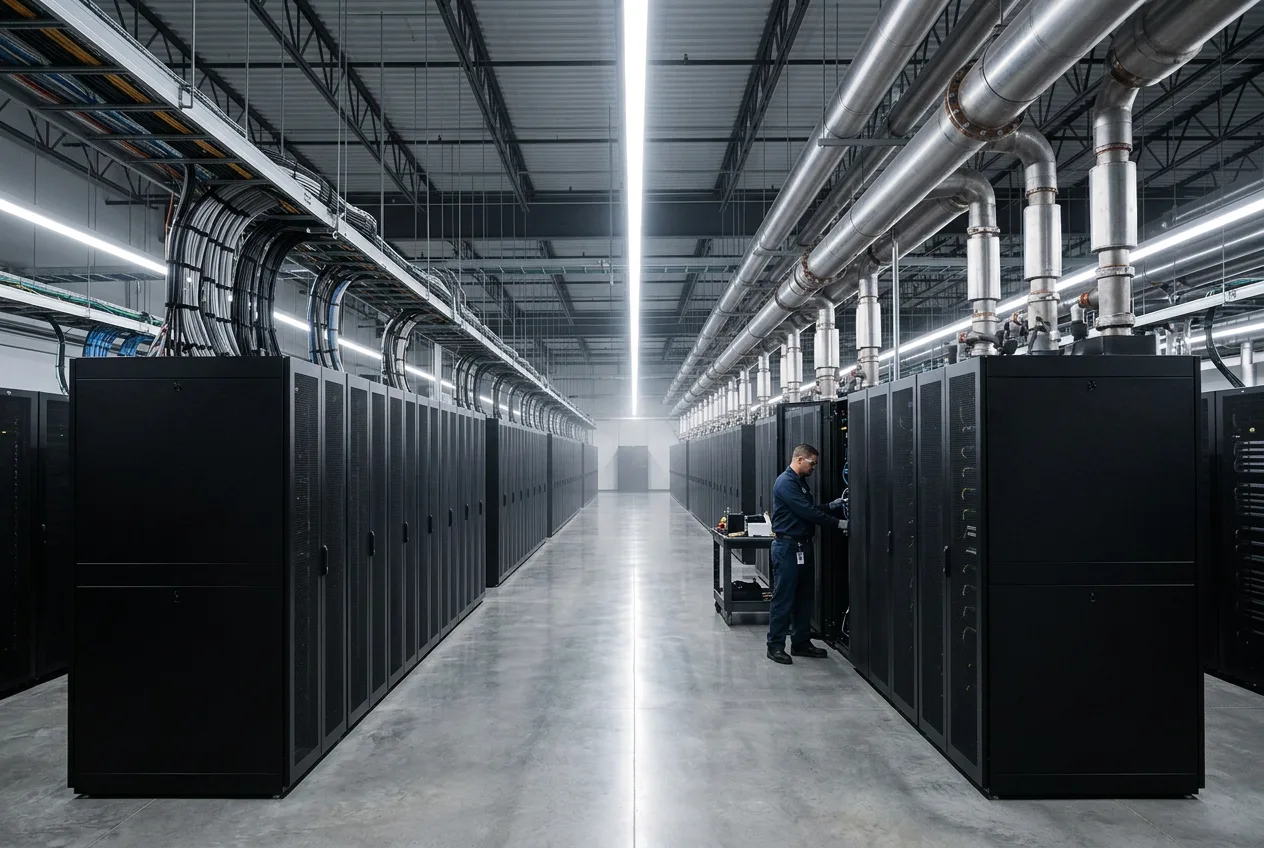
Epoch monitors several dozen large AI data centers that together represent about 44 percent of tracked global compute as of mid-2026. Power requirements have risen in parallel with compute additions, creating new constraints on grid connections and cooling infrastructure. The report highlights that next-generation chips from Nvidia and others will require continued monitoring of capex announcements and electricity availability.
Readers can download the underlying CSV datasets directly from Epoch to run their own calculations on capacity growth or regional allocation. Continued observation of Rubin and Blackwell deployment schedules will clarify whether the current nine-month doubling rate persists or moderates further in 2027.
Frequently asked questions
How does Epoch AI measure global AI compute capacity?
The organization converts quarterly chip sales from Nvidia, AMD, Google, Amazon, Huawei, and Cambricon into H100-equivalent units and fits an exponential trend line to the resulting time series.
What share of new AI compute went to the United States in 2026?
US facilities received 78 percent of new capacity additions in the first half of 2026 and 72 percent since 2022, according to Epoch's regional breakdown.
How fast is the installed base of AI chips growing compared with quarterly additions?
Total installed stock expanded 3.3 to 3.4 times per year since 2022, doubling every seven months, while new quarterly additions have doubled every nine months since 2024.
Which companies supply the tracked AI chips?
Nvidia, Google, AMD, Amazon, Huawei, and Cambricon account for the sales data used in the Epoch analysis.
By YasTech Editorial
Comments 2