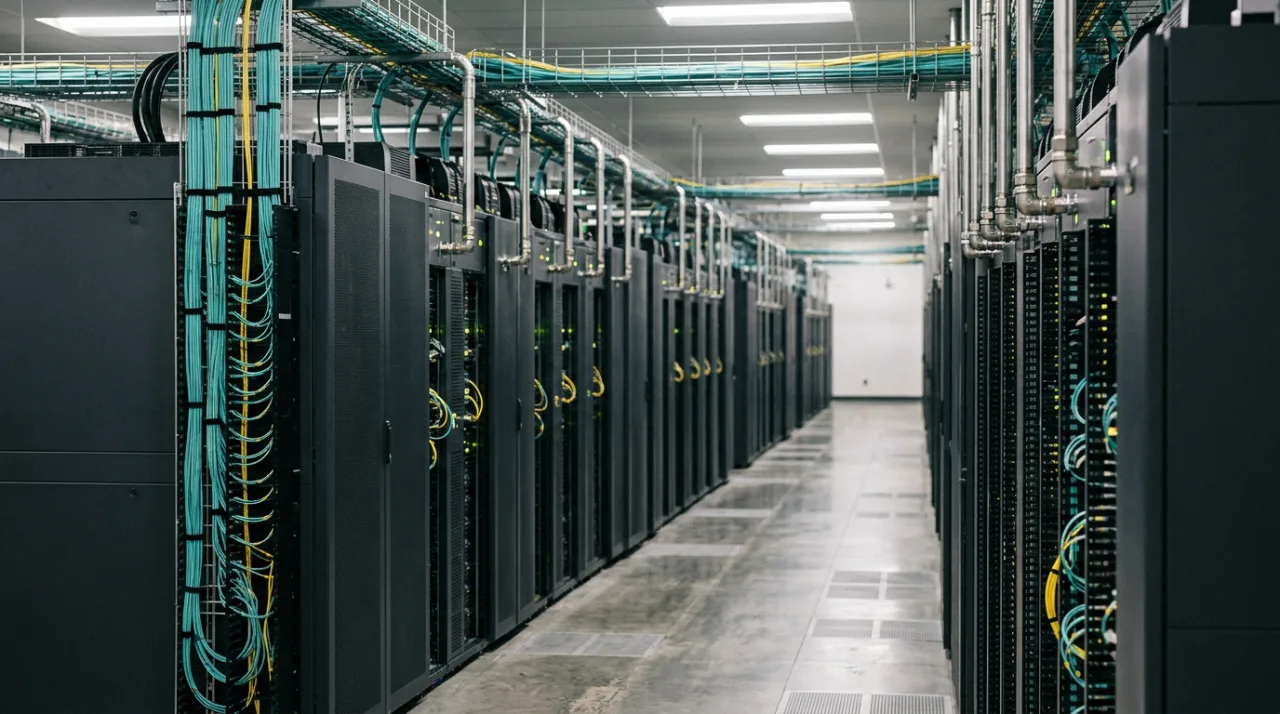
Google Cloud TPU v5p pods provide a peak aggregate performance of 4.11 exaflops in BF16 or FP8 dense compute across 8,960 chips. The configuration supports large-scale training of large language models, diffusion models, and other generative AI workloads. Availability began after general availability in 2024, with continued deployment through 2026 for internal Google projects such as Gemini model training.
Technical Specifications and Scaling Limits
Each TPU v5p chip delivers 459 TFLOPS peak performance in BF16 or FP8 formats, paired with 95 GiB of HBM memory at 2,765 GB/s bandwidth. The design includes two TensorCores and four SparseCores, connected through a 1,200 GB/s bidirectional Inter-Chip Interconnect in a 3D torus topology. A full pod assembles 64-chip cubes into the complete 8,960-chip system.
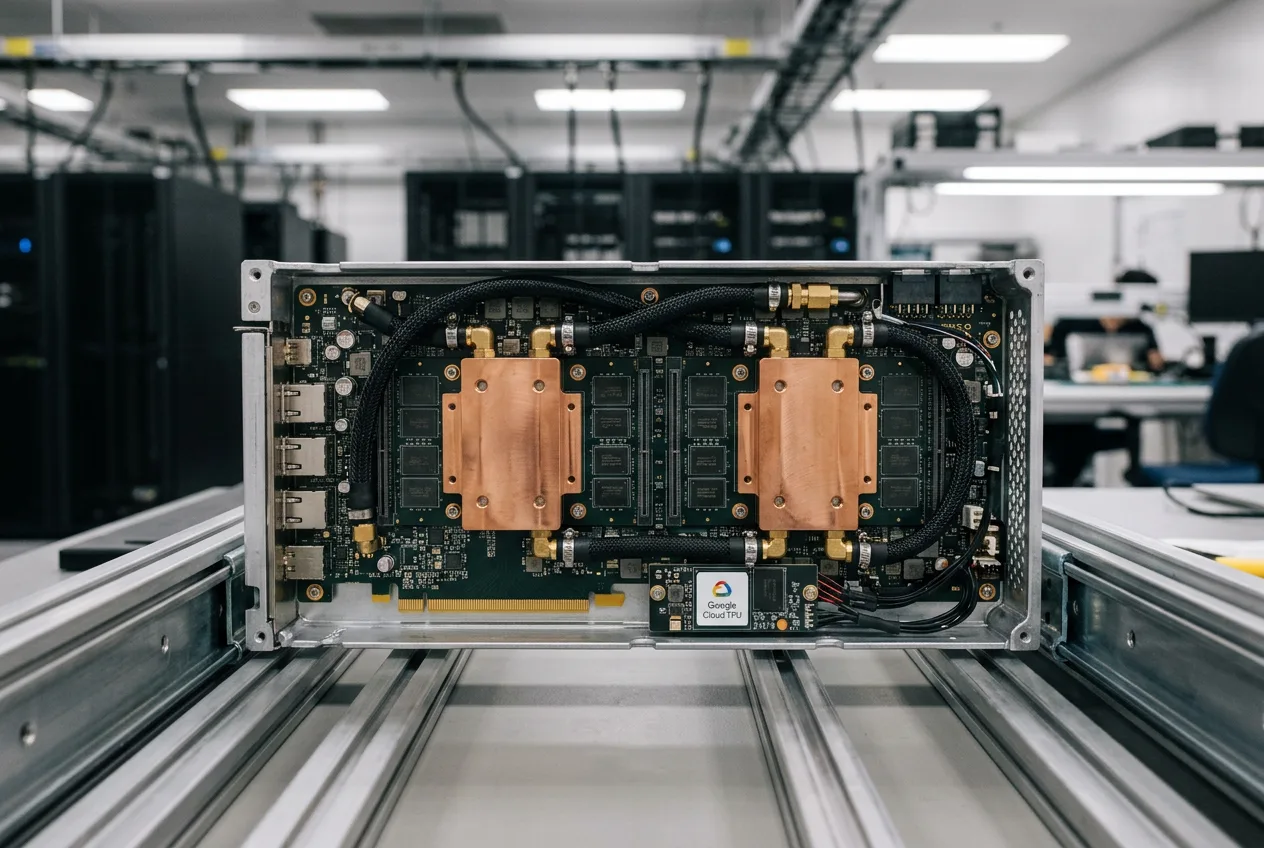
Single-slice jobs support up to 6,144 chips in topologies such as 16×16×24. Multislice configurations extend capacity to 18,432 chips across multiple slices. Compared with TPU v4, the v5p generation doubles per-chip FLOPS, triples HBM capacity, and increases pod-level scalability by roughly four times. Reported speedups include 2.8 times faster training for large language models and 1.9 times faster performance on embedding-dense workloads.
Machine type ct5p-hightpu-4t is offered in regions including us-central1, us-east5, and europe-west4. Supported frameworks include JAX, PyTorch via PJRT, and TensorFlow, with orchestration available through Google Kubernetes Engine and Cloud Pathways.
Benchmarks, Context, and Enterprise Implications
Model FLOPS utilization on MaxText workloads reaches 64 to 71 percent for models exceeding one trillion parameters as of late 2026. These figures reflect sustained efficiency on production-scale jobs rather than theoretical peaks. Later generations such as Trillium (v6e) and Ironwood have since entered the market with additional per-chip and pod-level gains.
Enterprise teams evaluating cloud AI accelerators can compare TPU v5p pods directly against GPU clusters by measuring both raw throughput and model-specific efficiency. The JAX and PyTorch integration reduces porting effort for existing codebases, while GKE support simplifies cluster management for multi-tenant environments. Organizations running repeated large training runs benefit from the fixed per-pod performance envelope, which aids capacity planning and cost forecasting.
Documentation from Google Cloud confirms the 4.11 exaflops figure for a complete pod; no public statements or independent verifications support higher aggregate claims. Teams planning infrastructure investments should reference current region availability and supported frameworks before committing to migration timelines.
Frequently asked questions
What is the peak performance of a full Google Cloud TPU v5p pod?
A complete TPU v5p pod with 8,960 chips reaches 4.11 exaflops in BF16 or FP8 dense compute, according to Google Cloud documentation.
Which frameworks does TPU v5p support for model training?
The platform supports JAX, PyTorch through PJRT, and TensorFlow, with orchestration via GKE and Cloud Pathways.
How does TPU v5p compare to the previous TPU v4 generation?
TPU v5p doubles per-chip FLOPS, triples HBM capacity, and scales pod size by approximately four times, delivering up to 2.8 times faster large-LLM training.
Where is Google Cloud TPU v5p currently available?
The ct5p-hightpu-4t machine type is offered in regions such as us-central1, us-east5, and europe-west4.
By YasTech Editorial
Comments 3