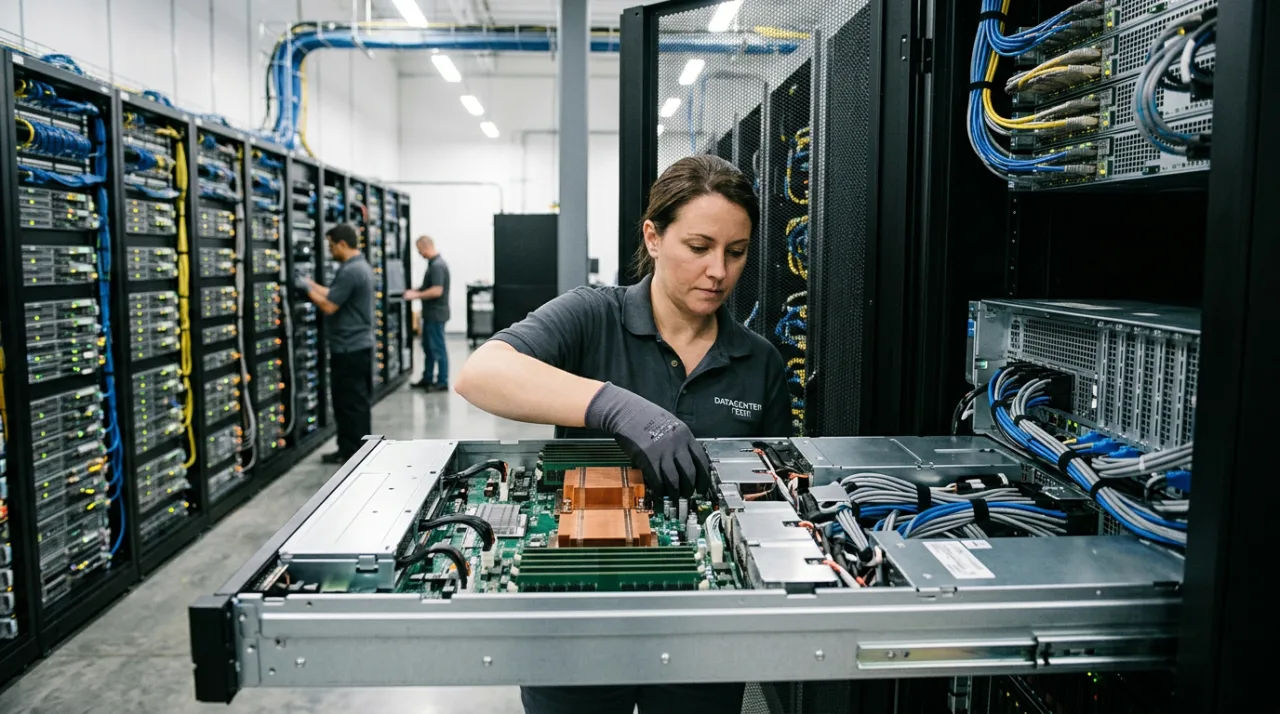
AWS has rolled out additional regional availability for Graviton4-powered EC2 instance families in November 2026, extending support for enterprise AI workloads that run on Arm-based CPUs. The instances target CPU-bound inference for small language models, data preprocessing, and embedding generation rather than GPU-accelerated training.
Official benchmarks show Graviton4 delivering up to 45 percent higher performance than Graviton3 on large Java applications and up to 40 percent on database workloads. These gains stem from 96 Neoverse V2 cores per socket, doubled L2 cache, and 75 percent higher memory bandwidth via 12-channel DDR5-5600.
Graviton4 Specifications and Measured Gains
Instance families now generally available include C8g, M8g, R8g, and storage-optimized variants with local NVMe. Configurations reach 192 vCPUs and 3 TiB of memory, with network bandwidth up to 600 Gbps on select models. AWS reports 30 percent average compute improvement across general workloads compared with C7g, M7g, and R7g instances.
Early adopters have deployed the instances for quantized small language model inference. Arcee AI reported competitive tokens-per-second figures on r8g instances when running inference pipelines. Ray and Anyscale users integrate the instances for distributed preprocessing steps before handing off to specialized accelerators.
Price-performance advantages remain central. Organizations migrating from x86 instances frequently record 20 to 40 percent lower total cost of ownership while maintaining or improving throughput on Linux workloads that support the Nitro System and EFA networking.
Enterprise Use Cases and Migration Path
Teams running network-intensive analytics or lightweight model serving find the instances cost-effective when full GPU clusters are unnecessary. The 45 percent uplift on Java-based inference services allows consolidation of instances without added latency.
Compatibility covers common frameworks including PyTorch and vLLM after standard Arm recompilation. Existing Graviton3 customers can migrate with minimal code changes because both generations share the same Nitro hypervisor and EBS integration patterns.
Hybrid setups that combine Graviton4 instances for data preparation with Trainium or Inferentia chips for heavier model stages are already in production at several financial and healthcare customers. These patterns reduce spend on always-on GPU capacity.
Continued Rollouts and Next Steps
Regional expansions for the C8gn, M8g, and R8g families continue through the end of 2026. AWS has also begun previewing Graviton5 instances that promise further 25 percent gains, positioning customers to plan hardware refresh cycles over the next two years.
Enterprises evaluating the platform should benchmark representative Java and Python workloads on m8g and r8g instances in their target regions. AWS provides free tier credits and Graviton-specific optimization guides that detail compiler flags and memory tuning for maximum efficiency.
Frequently asked questions
Which EC2 instance families use Graviton4 processors?
Current families include C8g, M8g, R8g, X8g and their storage-optimized variants with local NVMe. These instances became generally available progressively from mid-2024 onward with ongoing regional additions.
How much faster is Graviton4 than Graviton3 for AI tasks?
AWS benchmarks record up to 45 percent improvement on large Java applications and 30 percent on web and inference workloads. Actual gains depend on workload characteristics and optimization level.
Can Graviton4 instances run small language model inference?
Yes. Partners such as Arcee AI have published results showing strong tokens-per-second performance on r8g instances with quantized models. The instances suit preprocessing, embedding, and lightweight inference stages.
What migration steps are required from x86 instances?
Most Linux workloads require only recompilation for Arm. AWS supplies migration tools and documentation that cover common frameworks and container images.
By YasTech Editorial
Comments 1